Why Productivity Systems Fail for Most People
The Moment It Falls Apart
You open your to-do list.
There are twenty tasks staring back at you. Some from yesterday, some from last week, and a few you barely remember adding.
At first the system felt helpful. Everything had a place, tasks were organized into projects, and your work finally looked structured instead of chaotic.
But something slowly changes. The system that was supposed to make work easier begins to feel like another responsibility.
You adjust priorities. You move tasks between lists. You reorganize projects.
Eventually you spend more time managing the system than doing the work inside it.
This experience is surprisingly common. People try productivity systems with genuine excitement, only to abandon them weeks later when the structure that once felt helpful starts to feel exhausting.
The question isn’t why people struggle with productivity.
The more interesting question is why productivity systems themselves often fail.
What Is a Productivity System?
A productivity system is a structured method for organizing tasks, projects, and priorities so that work becomes easier to manage. These systems typically introduce rules for capturing tasks, categorizing work, and deciding what should be done next.
Many frameworks encourage people to maintain project lists, assign priorities, tag tasks, and schedule work across calendars. In theory, these structures should reduce chaos by creating order.
But structure does not automatically lead to action. In many cases, the systems designed to simplify work quietly introduce a new kind of complexity.
Why Productivity Systems Often Create More Friction
Most productivity systems assume that organization leads to clarity. If tasks are categorized correctly and priorities are labeled, the next step should feel obvious.
In practice, organization often creates more decisions rather than fewer. Every task needs to be categorized, prioritized, scheduled, or tagged before it feels properly placed inside the system.
Each of these decisions seems small, but together they create cognitive overhead. The brain must process the structure of the system before it can even begin processing the work itself.
Instead of asking a simple question like “What should I work on?” you begin asking operational questions.
Is this task high priority or medium priority? Should it live inside a project list or a backlog? Is today the right day to schedule it?
Over time the system becomes another environment your brain has to navigate before any meaningful work begins.
The Psychology Behind Productivity System Failure
The real issue is not that productivity systems are poorly designed. The deeper issue is that many of them misunderstand how human attention actually works.
Our brains are not built to evaluate dozens of possible actions at once. When too many tasks compete for attention, the mind slows down rather than speeds up.
Several psychological concepts explain why this happens.
Cognitive Load
Cognitive load refers to the amount of information your brain must actively process at a given moment. Human working memory is surprisingly limited, which means we can only hold a small number of ideas in focus at once.
When a productivity system surfaces dozens of tasks, projects, and priorities, it increases cognitive load every time you look at it. Instead of clarifying your work, the system creates a dense field of competing signals.
Ironically, the tool designed to organize your responsibilities becomes another source of mental clutter.
Decision Fatigue
Another factor is decision fatigue. Every decision consumes a small amount of mental energy, and productivity systems often require dozens of tiny decisions throughout the day.
You must constantly evaluate which task is most important, what priority level something deserves, and when something should be scheduled. Over time, the brain grows tired of making these judgments.
When decision fatigue sets in, the easiest decision becomes postponing action altogether.
Choice Overload
Research in behavioral psychology shows that increasing the number of choices does not always improve outcomes. In many situations, more options actually make decisions harder.
This phenomenon is known as choice overload.
Large task lists create the same effect. When someone opens a productivity app and sees thirty possible tasks, the brain struggles to determine where to begin.
Instead of creating clarity, the system introduces hesitation.
What Is Decision Paralysis?
Decision paralysis occurs when the presence of too many options prevents someone from making a decision at all. Rather than choosing between alternatives, the brain postpones the choice entirely.
In productivity systems this often appears as the familiar experience of staring at a long task list without starting anything. The mind begins evaluating possibilities, weighing urgency, effort, and importance.
Should you start the hardest task first, or begin with something smaller to build momentum? Maybe another task is technically more urgent. Or perhaps the list itself should be reorganized before starting anything.
This internal conversation consumes attention and energy. Minutes pass, sometimes hours, and the actual work has not yet begun.
The problem is not motivation.
The problem is the cost of deciding.
For a deeper exploration of this idea, see our article on how decision paralysis stops people from starting tasks.
The Hidden Problem With Most Productivity Systems
Many productivity systems assume that better organization automatically leads to better action. But organization and action are not the same thing.
You can build the most beautifully structured task manager imaginable and still struggle to begin working. Because starting requires something simpler than organization.
It requires clarity.
When someone opens a productivity tool and immediately sees dozens of unfinished tasks, the brain experiences something closer to threat detection than planning. The mind scans the list and registers obligations, deadlines, and unfinished work.
Instead of helping you focus, the system reminds you of everything you haven’t finished.
And that emotional weight quietly pushes people away from the system that was supposed to help them.
This is closely related to the issue explored in why traditional to-do lists often create overwhelm.
The Rule of Three Productivity Philosophy
A different approach to productivity focuses on reducing visible complexity rather than organizing it.
Instead of trying to structure every possible task, this philosophy emphasizes narrowing attention to a very small number of meaningful actions.
One simple framework that reflects this idea is the Rule of Three.
The concept is straightforward. At any given time, your attention should focus on only a few important tasks rather than an entire backlog of responsibilities.
Not twenty.
Not fifty.
Just a handful.
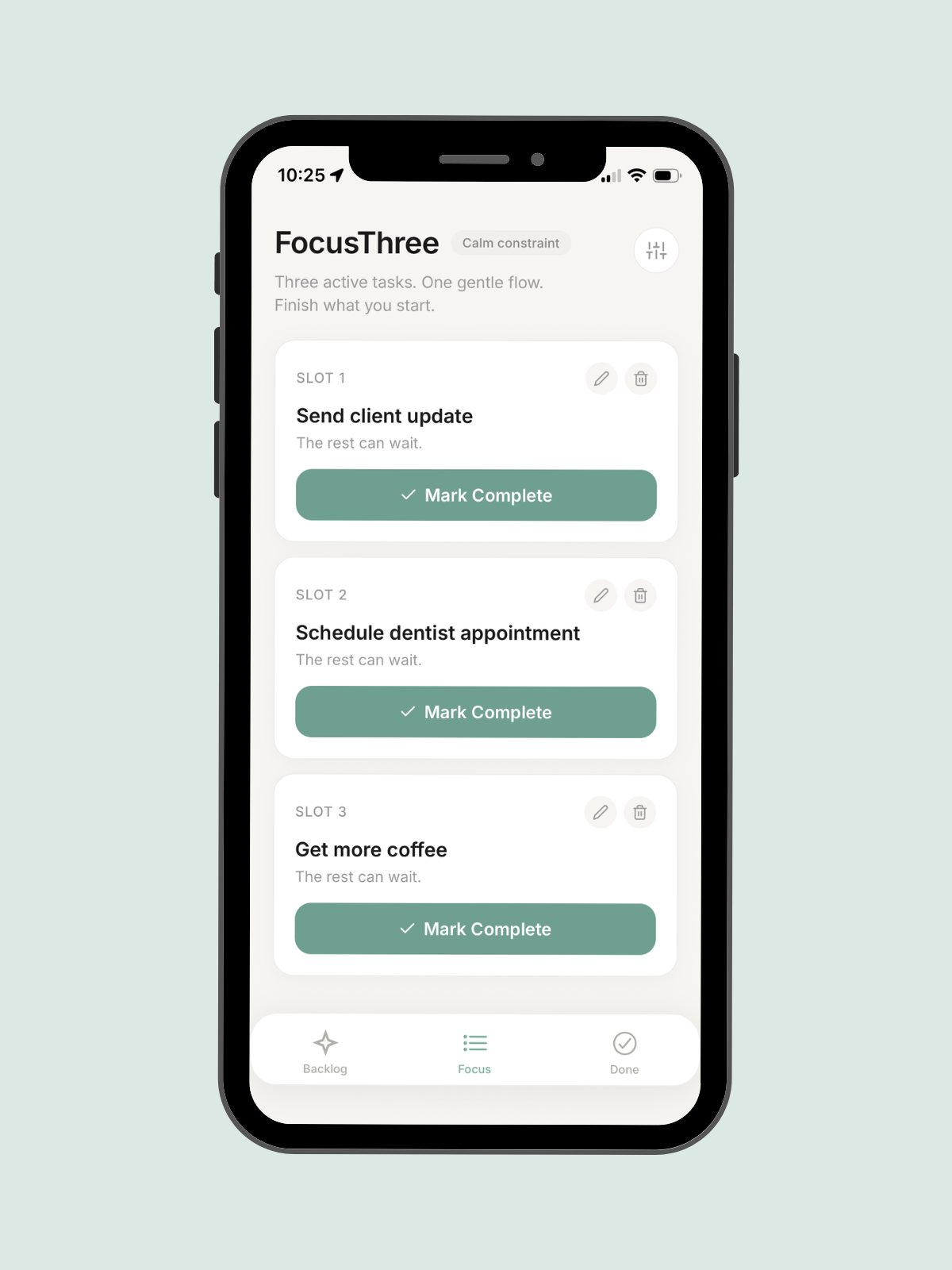
Limiting visible work dramatically changes how the brain experiences a task list. Instead of confronting a mountain of obligations, you see a small number of decisions.
Three tasks are manageable.
Three tasks create clarity.
Three tasks reduce the mental overhead required to begin.
If you're curious about the psychology behind this constraint, we explore it further in why limiting yourself to three tasks improves focus.
Some modern productivity tools are built around this philosophy. Instead of displaying dozens of tasks at once, they allow users to move only a few tasks into a focused workspace for the day.
How to Reduce Task Overload
If productivity systems often fail because they introduce too much complexity, the solution is not abandoning organization entirely. The solution is simplifying the interface between your brain and your work.
Step 1: Capture Everything
Your brain should not be responsible for remembering every task you need to complete. The first step in any effective system is capturing tasks somewhere outside your head.
This could be a notebook, a simple list, or a digital backlog. The goal is simply to remove the burden of memory so your mind can focus on thinking rather than remembering.
Once tasks are captured, they no longer compete for mental attention.
Step 2: Choose a Small Focus Set
Before starting work, select a very small number of tasks to focus on. This is where many productivity systems fail, because they expose the entire list instead of helping you narrow it.
Choosing just a few tasks creates clarity. It reduces cognitive load and makes the starting decision significantly easier.
For many people, three tasks is a surprisingly effective constraint.
Step 3: Start With One
Once your focus set is chosen, begin with a single task rather than trying to mentally commit to everything at once.
Momentum builds through action, not planning. The brain often resists large commitments but accepts small beginnings.
Finishing one task creates psychological movement, and movement makes the next step easier.
Why Starting Small Works
Human motivation rarely appears before action. More often, motivation follows action.
Once you begin working on something, the brain starts receiving signals that progress is happening. These signals trigger small bursts of reward chemistry that reinforce continued effort.
Psychologists sometimes refer to this as the progress principle. Even small signs of progress can significantly increase motivation and focus.
Large task lists interrupt this process. When dozens of unfinished tasks remain visible, the brain interprets progress as incomplete.
But when the visible workspace contains only a few tasks, progress becomes easier to perceive.
Finishing one of three tasks feels meaningful.
Finishing one of fifty barely registers.
This difference matters more than most productivity advice acknowledges.
Because productivity is not just about systems.
It is about how the brain experiences progress.
Key Takeaways
Productivity systems often fail because they increase cognitive load rather than reducing it.
Large task lists create decision fatigue and choice overload.
Decision paralysis occurs when too many possible tasks compete for attention.
Organization alone does not guarantee action.
Limiting visible tasks can dramatically reduce overwhelm.
Small focus sets make starting work easier.
Momentum and motivation usually appear after progress begins.
Closing Reflection
Most people assume productivity struggles come from poor discipline. But often the problem is structural rather than personal.
When systems expose us to too many tasks, too many decisions, and too many priorities, the brain slows down. It hesitates, postpones, and eventually avoids the system entirely.
The goal of a productivity system should not be to manage every task in your life.
It should be to make starting the next one easier.