Decision Paralysis: Why Having Too Many Tasks Stops You From Starting
You open your task list.
There are fifteen things on it.
Maybe twenty.
A few important work projects.
Some small errands.
A couple things you meant to do last week.
None of them look impossible.
Individually, they are all manageable.
But somehow you sit there staring at the list longer than you spend actually doing anything.
You scroll through the tasks.
You reorganize them.
You consider which one to start.
Then you check email.
Or Slack.
Or a different tab.
Another ten minutes pass.
Nothing has started yet.
This experience is incredibly common. It happens to students, knowledge workers, entrepreneurs, and anyone trying to manage a modern workload.
And the frustrating part is that it often has nothing to do with laziness or lack of discipline.
More often, the real problem is something psychologists call decision paralysis.
When too many possible actions compete for attention, the brain struggles to choose.
And when the brain struggles to choose, it often chooses something surprising.
It chooses nothing.
What Is Decision Paralysis?
Decision paralysis is a psychological state where having too many options makes it difficult to choose any option at all.
Instead of increasing freedom, an abundance of choices increases mental friction.
In the context of productivity, decision paralysis happens when a task list presents more potential actions than the brain can comfortably evaluate at once.
When that happens, starting becomes harder than expected.
Why Long To-Do Lists Create Overwhelm
Most productivity systems assume something simple.
More organization leads to more clarity.
The logic seems reasonable.
Capture everything you need to do.
Put it in a list.
Sort it by priority.
Work through it.
But in practice, the opposite often happens.
Large task lists increase cognitive load. If you're curious about the deeper psychology behind this, it’s helpful to understand why traditional to-do lists often create overwhelm in the first place.
Cognitive load refers to the amount of mental effort required to process information. Our brains have a limited working memory, meaning we can only evaluate a small number of things at one time.
When a list contains twenty tasks, your brain does not see twenty independent actions.
It sees twenty competing decisions.
Every time you look at the list, your mind begins asking questions:
Which one matters most?
Which one is easiest?
Which one is urgent?
Which one will take the longest?
Which one should happen first?
Even if these questions are happening subconsciously, they still require mental effort.
The brain must simulate each option before it can choose one.
And when the list grows large enough, the evaluation process becomes exhausting.
At that point the brain does something interesting.
It avoids the decision entirely.
The Psychology Behind Task Overload
Humans are not designed to evaluate dozens of competing options at once.
Research in behavioral psychology shows that when people are presented with too many choices, they often delay decisions or avoid making them completely.
This phenomenon is sometimes referred to as choice overload.
One famous study involved a grocery store display of jam.
When shoppers saw a table with six types of jam, they were much more likely to make a purchase.
When they saw twenty-four options, people stopped to look more often but purchased far less frequently.
More choices created more interest, but also more hesitation.
The same pattern appears in productivity systems.
A long task list creates the feeling of possibility.
But it also creates uncertainty.
Each task becomes one more thing the brain must evaluate before starting.
This leads to a subtle psychological effect.
The act of choosing becomes harder than the act of doing.
And when choosing becomes the bottleneck, progress slows down.
What Is Cognitive Load?
Cognitive load refers to the amount of mental processing required to understand or decide something.
Working memory, the part of the brain responsible for holding and evaluating information, has limited capacity.
Psychologist George Miller famously suggested that people can comfortably process about seven items at once, often fewer depending on complexity.
But tasks are not simple items.
Each task carries hidden variables:
How long it will take
How difficult it feels
How urgent it is
How much energy it requires
This means each task on a list consumes more cognitive bandwidth than it appears to.
When a list contains fifteen or twenty tasks, the brain is effectively juggling dozens of variables.
This is why simply looking at a long task list can feel tiring.
Your brain is already working.
Before any real work has begun.
What Is Decision Paralysis?
Decision paralysis happens when the mental cost of choosing becomes higher than the perceived benefit of acting.
The brain encounters too many possible paths forward.
Instead of selecting one, it stalls.
In productivity systems this often looks like:
Reorganizing tasks repeatedly
Moving tasks between lists
Sorting by priority again and again
Checking other apps or tabs
These behaviors feel productive, but they are usually signs that the brain is trying to avoid making a difficult choice.
The paradox is that the tasks themselves may not be difficult.
The decision is.
The Rule of Three Productivity Method
One of the simplest ways to reduce decision paralysis is to reduce the number of options visible at one time.
A helpful mental model for this is the Rule of Three.
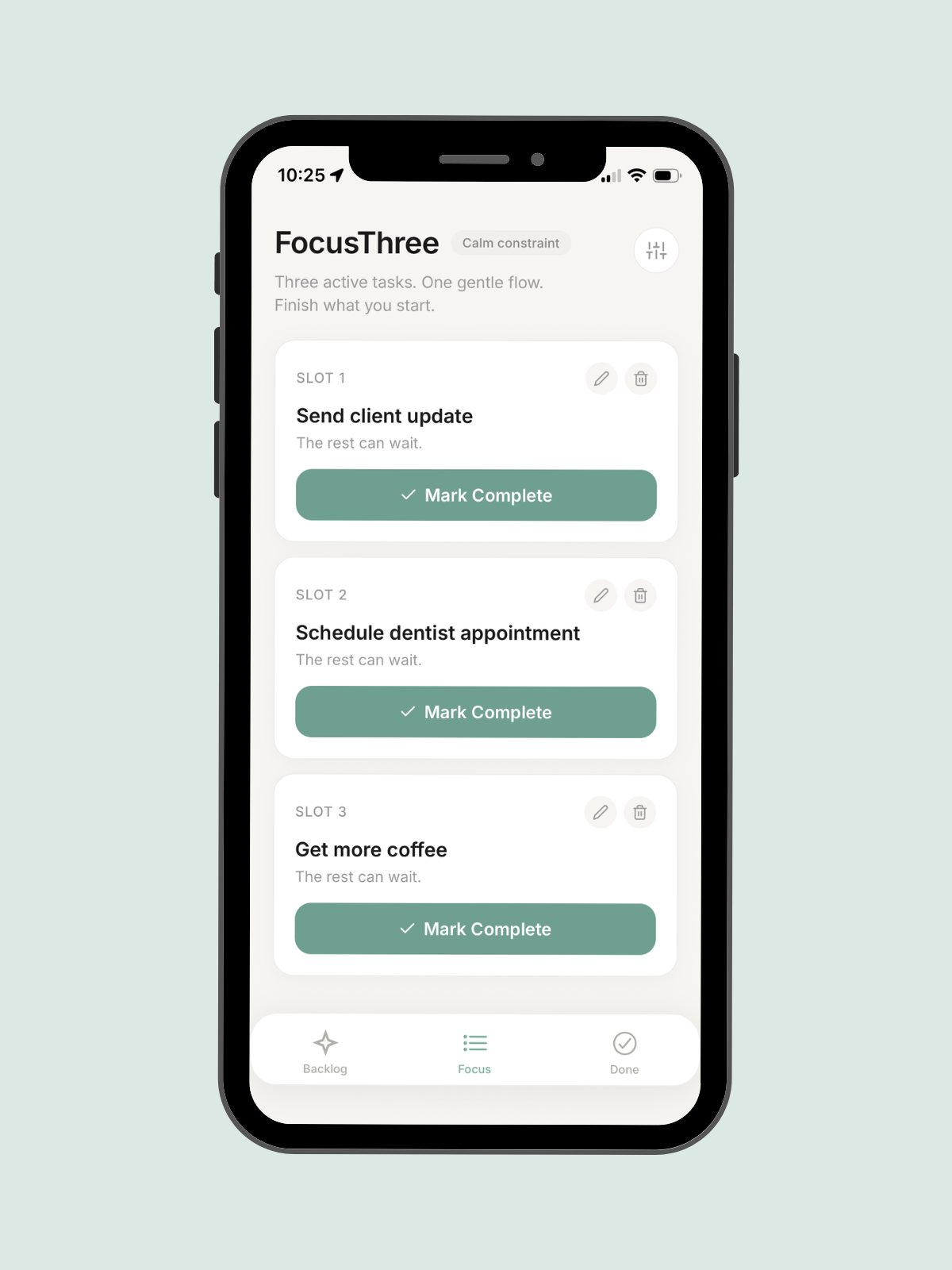
The Rule of Three suggests that instead of looking at your entire workload, you should focus on only three meaningful tasks at a time.
Not ten.
Not fifteen.
Just three.
Why three?
Because it sits in a useful psychological range.
One task feels too rigid.
Five or more tasks begins to reintroduce decision fatigue.
Three creates a middle ground.
There is enough flexibility to choose.
But not enough options to overwhelm.
When a person sees only three tasks, the brain can evaluate them almost instantly.
Instead of scanning a long list, the mind simply asks:
Which one should I start first?
The decision becomes small.
And when the decision becomes small, starting becomes easier.
Some modern productivity tools are built around this philosophy. Instead of presenting an endless list of tasks, they limit the visible focus to a handful of priorities for the day.
This small constraint often produces surprising clarity.
How to Reduce Decision Paralysis
Understanding decision paralysis is helpful, but the real benefit comes from adjusting how tasks are structured.
Here are a few practical steps that can reduce the mental friction that prevents starting.
Step 1: Capture Everything in One Place
First, remove the pressure of remembering tasks.
Ideas, responsibilities, and reminders should live somewhere outside your head.
This might be a notebook, a digital backlog, or a simple list.
The important part is that everything has a home.
When tasks are scattered across notes, emails, and reminders, the brain must constantly search for them.
Capturing tasks in one place removes that hidden mental load.
Step 2: Separate the Backlog From Today
Most productivity systems treat every task as equally visible.
This creates a long list that mixes today’s work with future responsibilities.
A more effective approach is separating tasks into two categories:
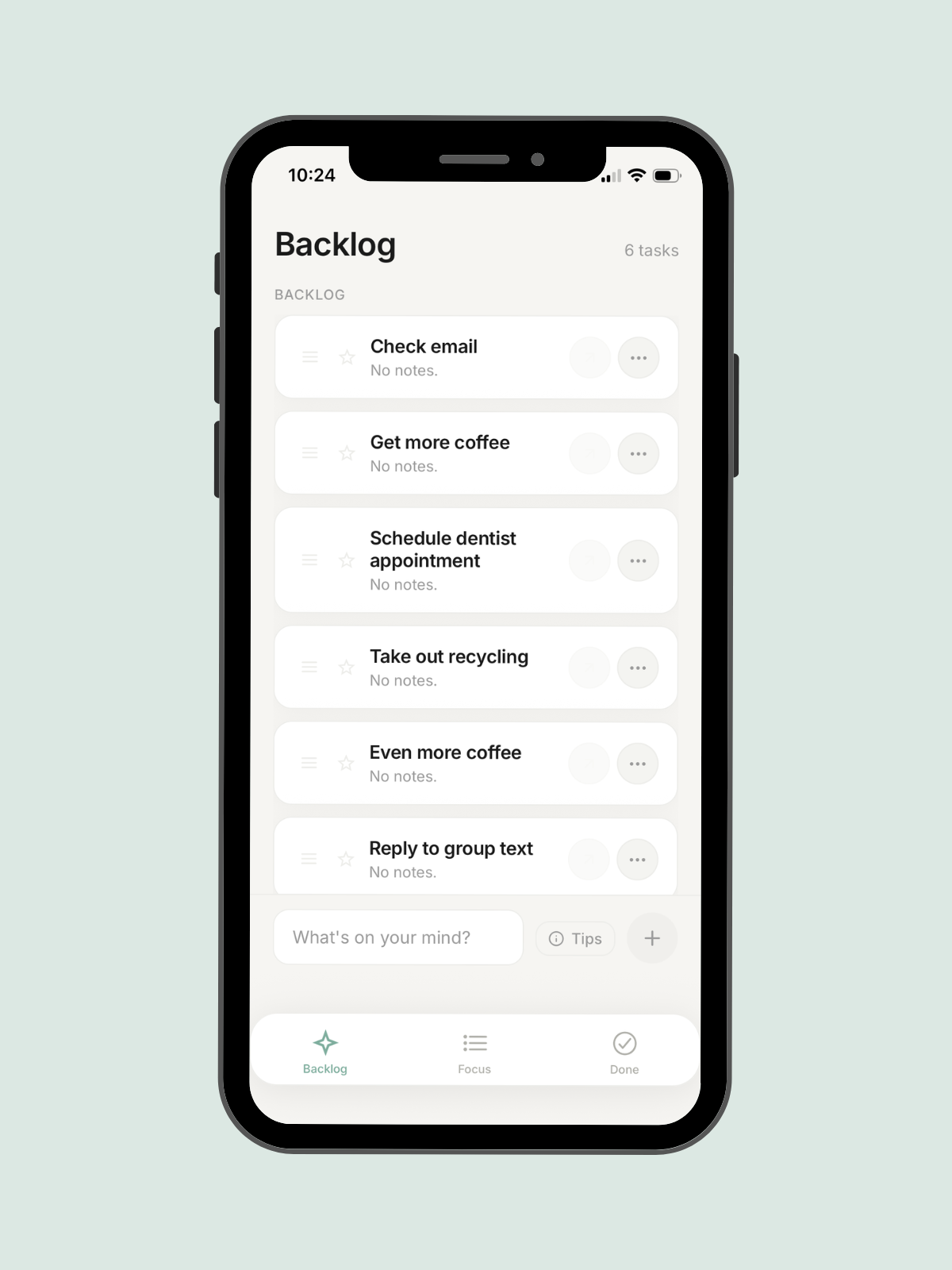
Backlog
Focus
The backlog holds everything that needs to happen eventually.
The focus list contains only the tasks that matter today.
This separation dramatically reduces visual clutter.
Instead of staring at twenty possibilities, you see only the few that actually require attention right now.
Some productivity apps implement this idea by allowing users to drag tasks from a backlog into a small daily focus area.
The interaction itself reinforces the idea that focus is chosen intentionally.
Step 3: Choose Three Tasks
Once tasks are captured and separated, choose three meaningful actions for the day.
Not tiny errands.
Not vague ideas.
Real tasks that move something forward.
This might look like:
Finish marketing dashboard draft
Write outline for blog article
Schedule client follow-up
Three tasks provide direction without overload.
When you sit down to work, the starting point is obvious.
Step 4: Start With the Easiest One
Another helpful strategy is beginning with the task that feels easiest to start.
Momentum matters.
Completing a small task reduces psychological resistance and increases the likelihood that you will continue.
The goal is not perfection.
The goal is motion.
Once motion begins, progress tends to follow.
Why Starting Small Works
Starting small works because motivation is often a result of progress, not the cause of it.
Many people assume they need motivation first.
But behavioral research suggests the opposite.
When people take small actions and see visible progress, their brain releases dopamine, a neurotransmitter associated with reward and momentum.
This creates a positive feedback loop.
Action leads to progress.
Progress leads to motivation.
Motivation leads to more action.
Large task lists interrupt this loop.
When the starting point is unclear, the first action becomes harder to initiate.
But when the starting point is obvious, the brain can move forward quickly.
This is why constraints can actually improve productivity.
Limiting visible tasks reduces cognitive load.
Reducing cognitive load makes starting easier.
And starting is often the hardest part.
The Hidden Benefit of Constraints
At first glance, limiting tasks might seem restrictive.
Wouldn’t seeing everything be better?
In reality, constraints often create clarity.
When options are unlimited, the brain struggles to prioritize.
When options are limited, the brain focuses.
Think about reading a menu with one hundred items versus one with ten.
The larger menu feels overwhelming.
The smaller one feels manageable.
Productivity systems work the same way.
By limiting the number of tasks visible at one time, you remove the noise that competes for attention.
The goal is not to eliminate responsibilities.
It is to reduce the mental effort required to start acting on them.
Key Takeaways
Decision paralysis is a common productivity challenge that emerges when too many possible actions compete for attention.
A few key ideas explain why this happens.
- Long task lists increase cognitive load and make decisions harder
- Choice overload can cause the brain to delay decisions or avoid them entirely
- Decision paralysis often appears as reorganizing tasks instead of starting them
- Limiting visible tasks reduces mental friction
- Focusing on three meaningful tasks helps create clarity and momentum
Reducing overwhelm is often less about doing fewer things.
It is about making it easier to start the right ones.
Closing Reflection
Productivity is often framed as a problem of discipline.
But many times the real obstacle is structure.
When a system presents too many options, the brain hesitates.
When a system simplifies the next step, the brain moves forward.
Starting rarely requires perfect motivation.
It usually requires a clear place to begin.
And sometimes the simplest way to find that place is to look at fewer things.
Not more.